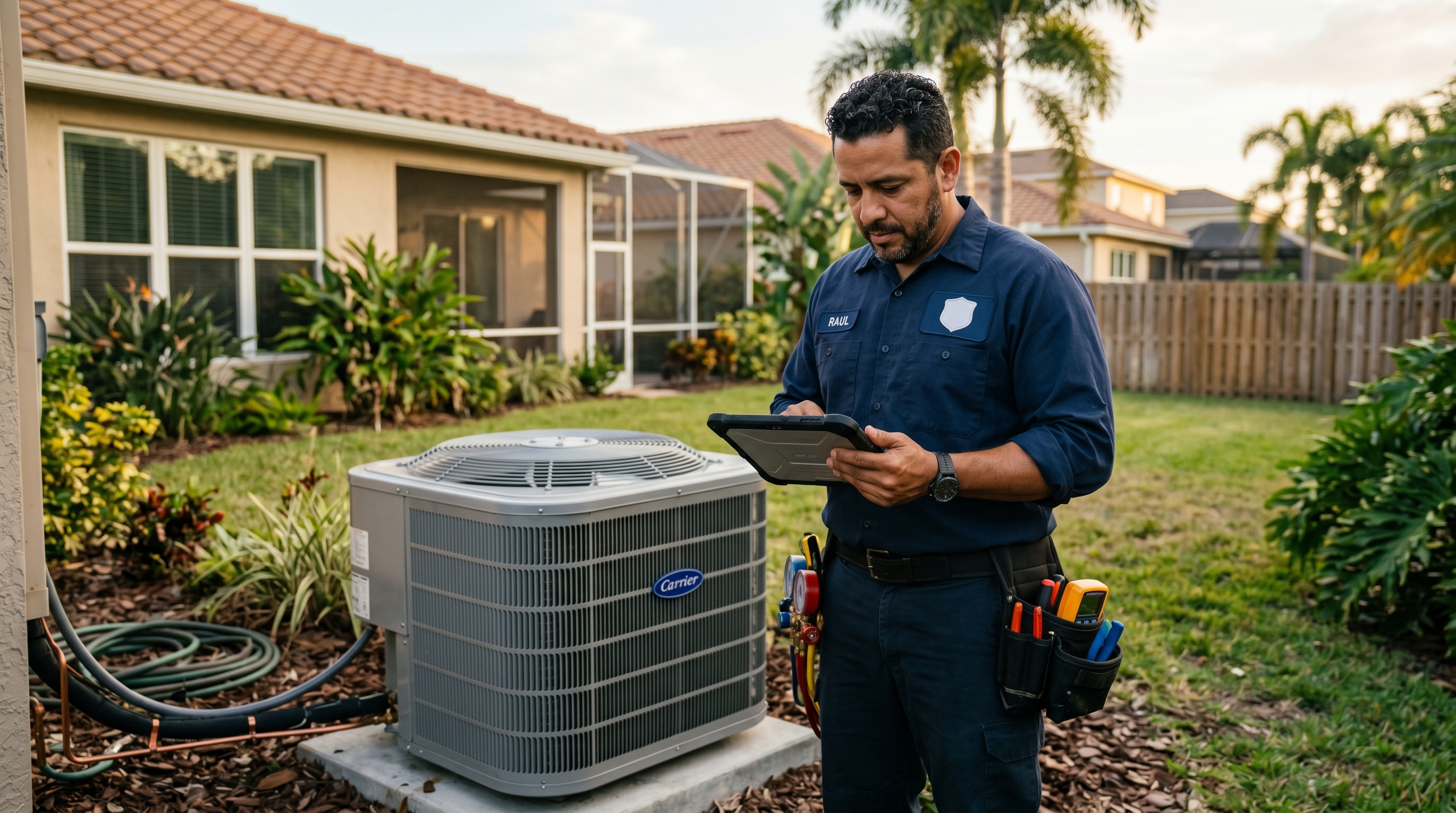
An air conditioner that dies on a Saturday afternoon, or a furnace that shuts off at midnight on a Sunday, is not a problem that waits until Monday. Those are precisely the moments — outside business hours, when no one is picking up the phone — when an HVAC company receives some of its most urgent, and usually most profitable, calls.
The problem is not technical: heating and cooling equipment fails according to physics and usage patterns, not according to a contractor's office hours. The problem is organizational. Most HVAC companies, especially smaller crews, simply have no one answering the phone after five in the afternoon or on weekends. That gap has a direct, measurable cost, even though it is rarely calculated.
Why are the most expensive calls exactly the ones that get lost?
HVAC emergencies are not evenly distributed across the week. Air conditioning systems experience the most stress when running at peak load, which tends to line up with hot afternoons and weekends, when people are home. Heating follows a similar pattern during cold snaps: the system runs continuously for hours before it fails, and that failure often happens overnight.
Layered on top of that is a customer behavior pattern worth understanding clearly: when someone loses climate control at home or at their business, they do not wait. They look for help immediately, and if the first call is not answered by a real person, they move to the next company on the list within minutes. No brand loyalty survives an unanswered hold tone when a family is dealing with extreme heat or a business has temperature-sensitive equipment.
The result is an uncomfortable paradox: calls arriving after hours tend to be, on average, the higher-ticket ones, because they combine real urgency with lower price-shopping tolerance. They are also the ones most often lost, because they land exactly when the company is unstaffed.
What does it actually cost to miss those calls?
The cost is not just the service that went unbilled that night. As a rough industry benchmark, every missed emergency call represents both the direct revenue from that job and the likelihood that once the customer resolves the issue with another company, they will not call back next time — or refer the original contractor to anyone else. In HVAC, where a customer's lifetime value includes annual maintenance and eventual equipment replacement, that compounding effect usually outweighs the value of the single call.
There is also a quieter reputational cost. Every time a potential customer calls and no one answers, there is a chance they leave a review mentioning the lack of response, even if they never became a paying customer. Over time, that pattern erodes the perception of reliability, which in an emergency-driven trade is essentially the brand's core asset.
What are the realistic options for covering after-hours calls?
There is no perfect solution — only different trade-offs between cost, quality of response, and ability to scale. It is worth looking at them honestly, without assuming one is automatically superior to the rest.
- Human answering service: an outside operator answers and takes a message or books an appointment. It is warmer than voicemail, but the operator rarely knows the business in depth, and cost scales with call volume.
- On-call technician: a team member rotates to handle emergencies. It provides real continuity and immediate technical knowledge, but has a physical limit — one person cannot handle two emergencies at once — and creates burnout if sustained week after week.
- Voicemail with next-day callback: the cheapest option, and in practice the one that loses the most opportunities, because it directly contradicts the customer behavior pattern described above — the caller has already reached someone else by the time the contractor calls back.
- Voice or WhatsApp AI agent: responds immediately, around the clock, can triage urgency, offer initial guidance, and book or escalate to the on-call technician only when genuinely needed. It does not replace a technician for diagnosis or repair, but it does handle the critical first minute, which is where the call is decided to stay with the company or go to a competitor.
How do you choose between these options without overspending?
The reasonable decision depends on after-hours call volume and team size, not on a generic preference for technology. A company with a handful of nighttime calls per month probably does not justify a fixed rotating on-call schedule, but it does benefit from something that answers immediately and separates what is urgent from what can wait until morning.
A useful rule of thumb, based on common industry estimates, is to compare the monthly cost of any solution against the value of a single emergency call that is answered well and converts into a job. If that comparison holds up even in a slow month, after-hours coverage stops being an expense and becomes an investment with predictable return.
It also pays to measure before investing: keeping a simple log of how many calls come in after hours, at what time, and how many turn into billed work gives a real basis for choosing between an answering service, a rotating on-call schedule, or an automated agent, instead of deciding by gut feeling.
What can an AI agent do that voicemail cannot?
The core difference is not availability — voicemail is technically "available" around the clock too — but interaction. A well-configured AI agent can ask the questions a technician would ask when picking up the phone: which system is failing, since when, whether there is risk to people (for example, heating cut off in the middle of winter with children or elderly people at home), and the exact address. With that information it can decide whether it is worth waking the on-call technician or whether the case can wait until first thing in the morning, and get it booked either way.
That triage capability is what reduces wear on the technical team without sacrificing the first response to the customer. The on-call technician stops being interrupted for every call and only gets activated when the case truly warrants it, while the customer who called at two in the morning already has an answer and an estimated time, instead of a hold tone.
Frequently asked questions
Is 24/7 on-call worth it if my HVAC company is small?
Not always in its traditional form of a technician rotating every night, because the burnout can outweigh the benefit for small teams. It is usually more sustainable to combine an immediate first response — human or automated — that filters real urgency, and reserve the technician's physical on-call status for those cases only.
Can an AI agent fully replace an on-call technician?
No. The AI agent answers, triages urgency, and books or escalates, but it does not diagnose equipment on-site or perform the repair. Its role is to make sure no call gets lost and that the technician only gets activated when the case justifies it.
How do I know if I am losing after-hours calls without realizing it?
The clearest signal is a pattern of inbound calls outside business hours with no record of a callback or a conversion into billed work. Reviewing the phone provider's call log for a month is usually enough to see the real volume, which is almost always higher than assumed.
What is the cheapest option to start covering nighttime calls?
It depends on volume, but generally a voice or WhatsApp AI agent has a lower and more predictable entry cost than a human answering service, and it avoids the burnout of a rotating on-call schedule from day one.